The most common hardwood floor installation patterns
Most hardwood floors go down in one of six patterns: straight lay, diagonal, mixed width, herringbone, chevron, or parquet. Straight lay covers the large majority of homes. The others trade more material and labor for a different look.
Straight lay runs every board parallel, with the end joints staggered so no two line up close together. It's clean, it suits almost any house, and it makes a room look longer in the direction the boards run. Plain strip oak laid straight, usually 2 1/4 inches wide, is what you'll find in a lot of older central Pennsylvania homes, from Harrisburg rowhomes to farmhouses in the valleys.
Diagonal is the same board laid at 45 degrees to the walls. It can make a small or boxy room feel wider and helps hide walls that aren't square, which is common in older houses. Every board at the wall gets an angled cut, so it takes longer and wastes more wood.
Mixed or random width combines two or three board widths, such as 3, 4 and 5 inch, in a repeating or random order. It fits farmhouse and colonial-style homes and can look like old plank flooring without needing very wide boards everywhere.
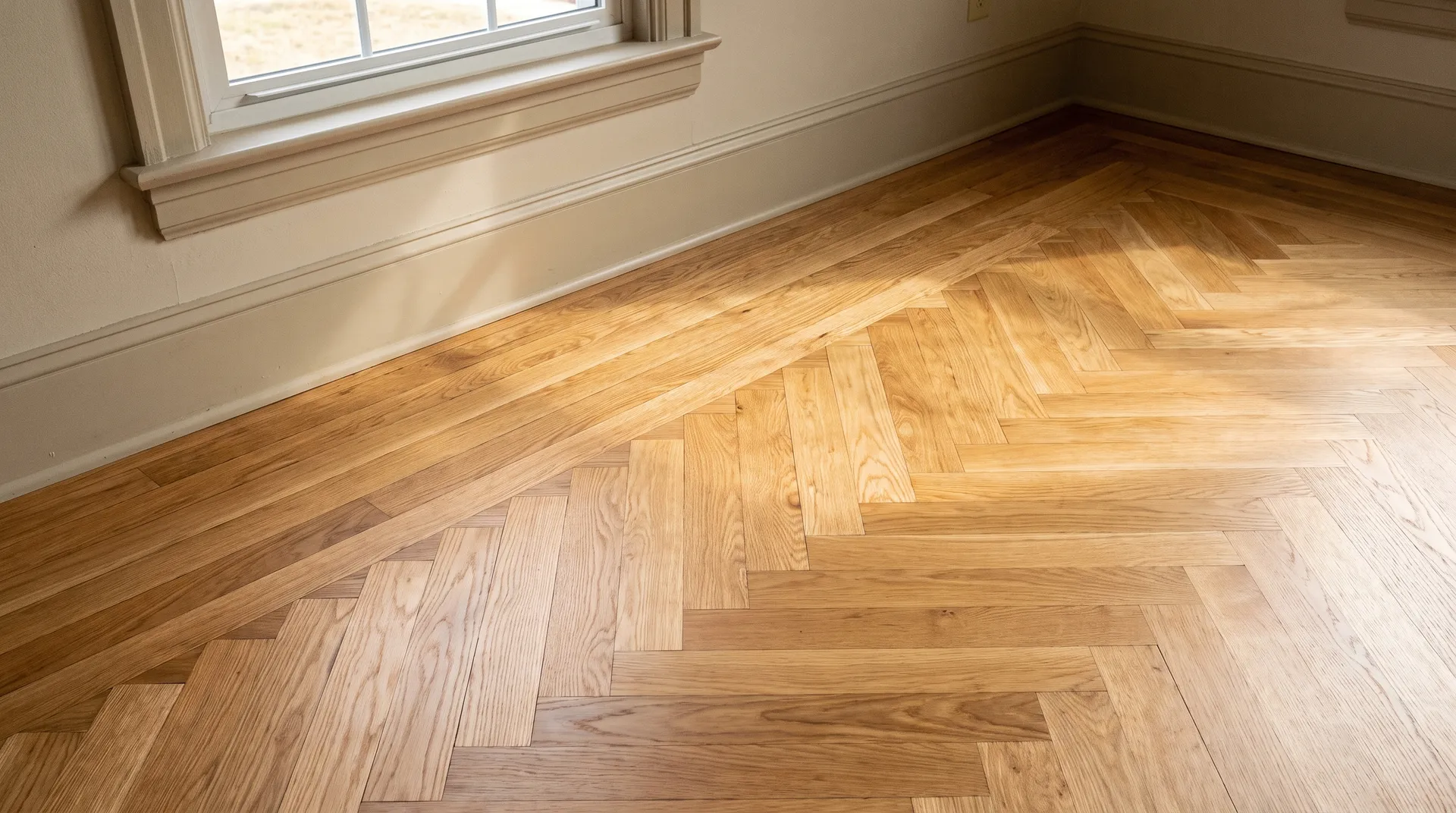
Herringbone, chevron and parquet are the detailed patterns. They show up most in entryways, dining rooms and living rooms where the floor is meant to stand out. Some people use them as a border or a single feature room and run straight lay through the rest of the house.
Herringbone vs chevron: what's the difference?
Herringbone uses rectangular boards with square ends set in a staggered zigzag, so the end of one board butts against the side of the next. Chevron uses boards with ends cut at an angle, usually 45 degrees, so the ends meet in a straight line and form a clean, continuous V.
Herringbone looks a bit busier and more traditional. Chevron reads as sharper and more modern, with a stronger sense of direction. With tongue-and-groove flooring, both patterns usually need left-hand and right-hand boards (often labeled A and B), so you can't just buy standard flooring and lay it at an angle.
Both patterns take far more layout than straight lay. The installer has to snap a centerline, lay out the first rows precisely, and keep the pattern square across the whole room, because a small drift at the start turns into a visible wander across 15 feet. Expect these floors to take noticeably longer to install than the same square footage in straight lay, often two to three times the labor.
Shorter boards in both patterns tend to stay stable through seasonal swings, since the movement in each piece is small. They also refinish well later. Today's sanding equipment handles the changing grain direction, though it takes care to keep sanding marks from showing across the grain.
Which direction should hardwood floors run?
Solid hardwood is usually installed across the floor joists, perpendicular to them, because that spreads the load and keeps the floor stiff. Within that rule, most people also run the boards along the longest wall or toward the main entrance or light source, because it makes the room look longer and calmer.
If you'd rather run the boards parallel to the joists, the subfloor generally needs to be built up first, often with an extra layer of plywood, so the boards don't sag or bounce between joists. Diagonal and herringbone patterns avoid the problem because no board lines up exactly with the joists.
In a house with connected rooms, it usually looks better to keep one direction through the main living area than to turn the boards at every doorway. Hallways are the exception people argue about most. Boards running the length of a hall look natural, but if that goes against the joists, it may call for subfloor work.
Older homes in this part of Pennsylvania often have board sheathing or plank subfloors instead of plywood, and joists that aren't always evenly spaced. Checking what's under the floor before choosing a direction saves surprises once the old flooring comes up.
How much extra flooring does each pattern need?
Plan on about 5 to 10 percent extra wood for straight lay, 10 to 15 percent for diagonal, and around 15 to 20 percent for herringbone or chevron. Rooms with lots of corners, closets, or angled walls push those numbers higher.
The extra covers cuts at the walls, boards with defects you don't want in the floor, and the off-cuts that are too short to use. Diagonal and the zigzag patterns waste more because nearly every board that meets a wall gets cut at an angle.
It's worth keeping a box or two of leftover flooring after the job. Boards from the same run are the closest match you'll ever get if a section needs repair later, and wood bought years later rarely matches the color and grain of the original.
Labor follows the same pattern as material. Straight lay goes fastest, diagonal adds cutting time, and herringbone or chevron adds layout and fitting time on top of that. That's the main reason detailed patterns cost more per square foot even with the same wood.
Should hardwood floors be nailed or glued?
Solid hardwood over a wood subfloor is usually nailed down with flooring cleats or staples, which is the traditional method and holds the floor tight for decades. Glue-down is mainly for engineered hardwood over concrete, and for some herringbone and parquet work where the short pieces are easier to set in adhesive.
Nailing needs a wood subfloor, plywood, OSB, or old plank sheathing, thick and sound enough to hold the fasteners. Solid hardwood also isn't meant to go below ground level, so basements usually get engineered flooring or LVP instead.
Gluing works over concrete slabs, but the slab has to be tested for moisture first and the adhesive has to suit the flooring. Some installs use both, gluing and nailing together, which is common with wide plank to help keep the boards flat.
Floating floors, mostly engineered wood and LVP, aren't fastened down at all. They click together and rest on an underlayment. They go down faster but sound and feel different underfoot from a nailed solid floor, and solid hardwood floors can be sanded and refinished more times.
How long should hardwood sit in the house before installing?
Hardwood should sit in the house until its moisture content is close to the subfloor's, which often takes about 3 to 5 days but sometimes longer. A moisture meter decides when it's ready, not the calendar. A common guideline is within about 4 percent of the subfloor for narrow strip flooring and within about 2 percent for wide plank.
The house needs to be at normal living conditions while the wood sits: heat or air conditioning running, windows closed, and any drywall, plaster or paint already dry. Wood sitting in a damp, unheated house just soaks up moisture it will lose later.
Central Pennsylvania's climate makes this matter. Humid summers make wood swell, and dry winters with the furnace running make it shrink, so some small gaps between boards in January are normal. Installing in fall, as heating season starts, works well as long as the wood has caught up with the indoor air. Wider boards move more than narrow ones, which is one reason narrow strip oak has held up so well in older homes here.
Charlie's Sanding & Refinishing is a hardwood floor company based in McAlisterville, PA, that installs, sands, refinishes and stains hardwood floors and staircases within about 60 miles, with State College and Harrisburg as its main cities. If you're extending an existing floor into a new room, we match the color and finish so the new boards blend in with the old.
Questions we hear
Can you install hardwood flooring yourself?
Yes, a handy homeowner can install a straight-lay, nail-down floor in a simple room with a rented flooring nailer and a lot of patience. The hard parts are getting the first row straight, keeping end joints staggered, and checking moisture before you start. Diagonal, herringbone and chevron patterns are much harder to get right, and mistakes are expensive to undo once the boards are nailed.
Can you put new flooring over old hardwood?
Often you can. Floating floors like LVP or engineered wood can go over old hardwood that's flat and solid, and new solid hardwood can be nailed over it if the boards run across or diagonal to the old ones. The catch is height: the new layer can cause problems at doors, stair nosings and transitions to other rooms. If the old hardwood is sound, sanding and refinishing it is usually worth considering first.
What affects the cost of installing 2,000 square feet of hardwood floors?
The biggest factors are the wood species and grade, solid or engineered, the pattern, and how much subfloor prep the house needs. A herringbone or diagonal floor takes more material and labor than straight lay over the same area. Removing old flooring, moving trim, stairs, and whether the floor comes prefinished or gets sanded and finished on site all change the total. The only way to get a real number is to have the space measured.
Can new hardwood match an existing floor when adding a room?
Usually, yes. The new boards should be the same species, width and cut, laid in the same direction, and woven into the existing floor instead of butted against it in a straight seam. Then the old and new areas are typically sanded and finished together so the color and sheen match.
Which hardwood floor pattern works best in a small room?
Straight lay along the room's longest dimension is the safe choice and makes the space look longer. Diagonal can make a small, square room feel wider and hides walls that are out of square. Herringbone works in small spaces like entryways too, but in a very small room the pattern can feel busy, so it helps to look at a sample laid out on the floor first.
Do patterned hardwood floors cost more to refinish later?
Patterned floors can be sanded and refinished like any solid hardwood floor, but they take more care. Because the grain changes direction from board to board, the sanding has to be done carefully so scratch marks don't show across the grain. Plan on that taking somewhat longer than a straight-lay floor of the same size.